


Working conditions
HHLA’s appeal as an employer largely depends on its working conditions. Health and safety, secure employment, working hours, adequate wages, collective bargaining agreements and work-life balance are seen as key levers to ensure employees’ standard of living and facilitate life stage-oriented work.
Health and safety
Occupational safety policy
The physical well-being and safety of its own employees, the employees of external contractors, customers, suppliers and visitors is a top priority for HHLA. From an occupational health and safety perspective, “own workforce” is defined, based on statutory rules, as all HHLA employees (including Executive Board members and Managing Directors) plus external company employees. An exception to this coverage is the care provided by HHLA’s company doctors (in Hamburg), from which external company employees are excluded.
The occupational safety policy is designed to prevent accidents at work and work-related illnesses. This objective is outlined in the occupational safety policy, which is binding for all companies that are not certified to ISO 14001 and ISO 45001. The Director of Labour Affairs is responsible for ensuring compliance with the occupational safety guidelines and the associated occupational safety policy. Binding rules in this regard are laid down for all companies certified in Germany in the health, safety and environmental protection guidelines. HHLA achieves a coverage of more than 92 % of employees in this regard in Germany, while internationally the figure is 39 %, resulting in an overall rate of 87 %.
in % |
|
31.12.2025 |
||||||
|---|---|---|---|---|---|---|---|---|
Percentage of employees covered in Germany |
|
92 |
||||||
Percentage of employees covered abroad |
|
39 |
||||||
Percentage of employees covered across the Group |
|
87 |
||||||
|
||||||||
With its HSE (Health, Safety and Environment) guidelines and occupational health and safety guidelines, HHLA undertakes to guarantee that relevant national occupational safety legislation, ordinances and regulations of the employers`liability insurance associations are implemented and to ensure compliance through comprehensive preventive measures and guidelines.
Actions are adopted to protect all employee groups affected by its activities. These groups include HHLA’s own employees, including board members, managing directors, students on work placement, and interns, as well as employees of external companies. Mandatory health and safety requirements apply to all of these groups, tiered according to their contractual relationship.
HHLA reviews whether the policy is appropriate for defining and achieving its objectives during management audits once a year. The review is undertaken regardless of whether the company concerned applies the HSE guidelines or the occupational safety guidelines.
HHLA ensures that the legally mandatory positions, such as occupational safety officers and company doctors, are filled in all companies. For the companies located in Germany, these positions are assigned to the Occupational Health and Safety Management staff department or are outsourced. The individual companies are responsible for appointing their own safety officers and first aiders.
Financial resources are provided for trainings, workplace extensions and safety equipment. The precise scope of resources forms part of HSE controlling.
When new work equipment and methods are introduced at HHLA company sites in Germany, the Group’s occupational health and safety organisation is closely involved in planning processes in order to adapt them to changing conditions within the company and to reflect the latest safety-related findings. On an international level, this is managed through the delegations in the companies concerned. At the international subsidiaries, occupational safety must be included in risk assessments; this is a minimum requirement for integrating occupational safety into planning activities. Any necessary risk minimisation actions are derived from these risk assessments.
Occupational health staff provide tailored guidance on prevention measures and assist with designing work environments. This is intended to promote and maintain employee health and productivity, also in the long run. First aid arrangements are made in accordance with local statutory provisions.
The HSE policy can be found internally on HHLA Inside (intranet). HHLA’s general policy is published on its website. Relevant information for employees of external companies is made available on the HHLA website in the Customers section.
Actions
The occupational health and safety perspective at HHLA focuses on comprehensive prevention measures. We ensure that accidents at work and health risks are minimised for all employees by rigorously implementing occupational safety measures, including ISO 45001 certification and targeted training programmes. To this end, internal programmes and guidelines serve as group-wide corporate regulations applicable on an international level. These are based on national legislation and international standards and stress both the obligation of managers to act responsibly and the personal responsibility of employees. Occupational safety measures are subject to a continuous improvement process.
The Group has implemented extensive occupational safety and health protection measures to minimise health risks and prevent accidents at work and injuries to employees. These initiatives cover a wide range, from strategic risk management to individualised health promotion programmes.
These include:
regular servicing and preventive maintenance to ensure the technical safety of plant, machinery and operating resources, thus helping prevent unexpected incidents in the company
regular inspections at the different companies and, where applicable, at any places where work is performed outside the companies
internal and external audits to ensure continuous checking and optimisation of plant, processes and working conditions
HHLA provides in-house health promotion and social counselling services for the companies located in Germany. There are also company agreements on mental health and on preventative medical check-ups.
Moreover, there are regular training actions and awareness-raising campaigns for employees. These cover numerous topics, including handling hazardous materials, understanding systems and processes, and available support services.
Various measures are implemented that promote safety awareness, safe behaviours and a culture of safety for the long term. These include:
Annual or situation-dependent trainings and briefings
Alarm and hazard prevention plans, which are tested annually through fire and evacuation drills
Ergonomic workplace design
Counselling for personal or work-related crises
The reporting period also saw the successful introduction of the EVA - the programme for attitude and behaviour change in occupational health and safety in selected companies located in Germany.
Companies which apply the EVA method to their work practices
HHLA Holding
Container Terminal Altenwerder
Container Terminal Burchardkai
Container Terminal Tollerort
Service Center Altenwerder
Service Center Burchardkai
Frucht- und Kühlzentrum
Hamburger Container und Chassis Reparatur
Kombi Transeuropa Terminal
The Container Terminal Tollerort (CTT) is in the final phase of implementing the programme with implementation currently under way at holding level. Relevant actions are still at the planning stage for HCCR and FKZ. The behaviour-based approach aims to encourage positive safety habits among employees for the long term. Specific trainings for all managers aim to ensure that safe practices are successfully integrated into daily work routines. The decision whether to adopt the EVA programme as a Group standard is currently still pending.
The behaviour-focused EVA programme has had a positive impact on safety culture and safety awareness, as evidenced by a reduction in the number of accidents. Potential pressures such as physically demanding activities, shift work and stressful situations during everyday operations are also being systematically identified and addressed: evolving working conditions, growing automation and even extreme weather events create opportunities to improve employees’ physical and mental health. Continuous improvement of ergonomics, the use of digital assistance systems and greater awareness of safe behaviour provide starting points for prevention.
A software-based occupational safety management system is used to verify that the documentation and organisation of all occupational safety measures comply with legal and data protection requirements.
As part of contractor management, instruction and orientation are provided to ensure that the employees of external service providers can also work safely. Access to safety-critical areas is restricted to authorised personnel who have completed the required orientation or training.
Before any work is commenced, external contractors must inform their employees and any subcontractors they deploy about HHLA’s occupational safety regulations, using the “Occupational health and safety regulations for external companies” information sheet as a basis. Whenever there is a change in staff, employees assigned to a workplace or site for the first time receive instruction prior to commencing work. Thereafter, they undergo training regularly, at least once a year.
The shift towards climate-neutral port operations entails structural changes such as the use of alternative propulsion systems or the electrification of equipment. As a result of these changes, initial and ongoing training on safety-relevant topics is required in order to prevent potential hazards in handling new technologies. This training is being conducted as planned.
Management system
HHLA has implemented its HSE management system in line with ISO 14001 and ISO 45001 for the following companies in Hamburg.
German companies certified to ISO 14001 and ISO 45001
-
HHLA Holding
-
Container Terminal Altenwerder
-
Container Terminal Burchardkai
-
Container Terminal Tollerort
-
Service Center Altenwerder
-
Service Center Burchardkai
-
Fischmarkt Hamburg-Altona
-
Frucht- und Kühlzentrum
-
Hamburger Container und Chassis Reparatur
-
HHLA-Personal-Service Gesellschaft
-
Kombi-Transeuropa Terminal
-
METRANS Rail Deutschland GmbH
-
UNIKAI
In addition to the companies located in Germany, a number of international subsidiaries also hold ISO 14001 and/or ISO 45001 certification.
International companies certified to ISO 14001 and/or ISO 45001
-
Container Terminal Odessa
-
HHLA PLT Italy
-
METRANS (Polonia)
-
METRANS a.s.
-
METRANS Danubia a.s., Slovakia
-
METRANS (Danubia) Kft. Gyor/Hungary
-
METRANS DYKO Rail Repair Shop
-
METRANS Konténer
-
METRANS Rail Slovakia
- METRANS Rail sp.z.o.o
-
Univer Trans
- Logistica Guiliana Srl
-
TK Estonia
The management systems are designed to increase employee health and safety, reduce environmental impacts and ensure compliance with regulations and best practices with regard to health, safety and environmental protection. They define tasks, processes and responsibilities relating to environmental protection, occupational health and safety as well as emergency management and hazard prevention, thus forming the basis for consistent fulfilment of statutory and voluntary HSE requirements.
As already stated, all companies outside the scope of the certified management systems are subject to the occupational safety guidelines, which set minimum standards and require compliance with national laws and regulations.
Responsibility for the occupational safety guideline documents rests with HHLA Holding, while responsibility for their implementation lies with the subsidiaries. HHLA Holding also assumes overall responsibility/responsibility for implementation within its own remit.
Employees are systematically involved in occupational health and safety matters through statutory participation structures, especially works councils and employee representatives. Occupational safety officers, safety officers and managers are also regularly involved in setting objectives, planning actions and overseeing their implementation and measurement. Effectiveness is also reviewed and improvement measures defined on a joint basis.
Employees have access to a multi-tier system for raising concerns or complaints relating to occupational health and safety. This includes the Works Council, the internal complaints management system, the Occupational Health and Safety Management staff department and a whistleblower hotline. The latter is also available in the relevant local language at HHLA’s European sites. Moreover, there is a section on the portal which provides answers to key practical questions. Confidentiality and protections are guaranteed for individuals reporting concerns.
In the aforementioned certified companies, setting clear HSE ambitions such as climate neutrality and the zero-accident ambition allows continual improvement of HSE performance and targeted investments in state-of-the-art technology to be achieved.
Objectives are also formulated for all other companies not covered by the certified management system. These objectives are specially dimensioned for each company and seek to ensure continuous improvement in occupational safety.
Comprehensive controlling and internal audits regularly check whether and how the HSE management system requirements are implemented in day-to-day operations.
Evaluation is conducted using a structured HSE controlling system which incorporates not only established KPIs such as the LTIR (lost time injury rate) and the accident rate but also qualitative feedback from audits, review meetings and lessons-learned workshops.
Overall responsibility for occupational health and safety lies with the HHLA Executive Board, specifically with the Director of Labour Affairs. The individual companies or the relevant departments are responsible for implementation on an operational level, in coordination with the specialist departments and subsidiaries. In HHLA companies located in Germany, this responsibility lies with the Occupational Health and Safety Management staff department.
PDCA cycle: Plan – Do – Check – Act
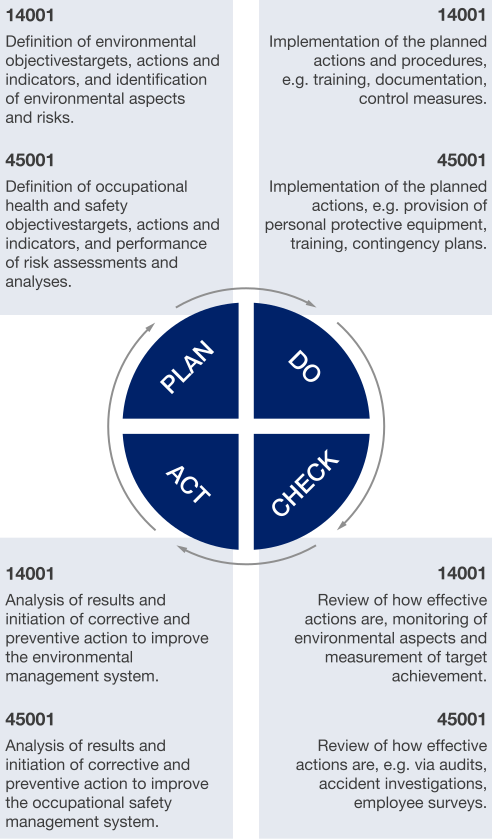
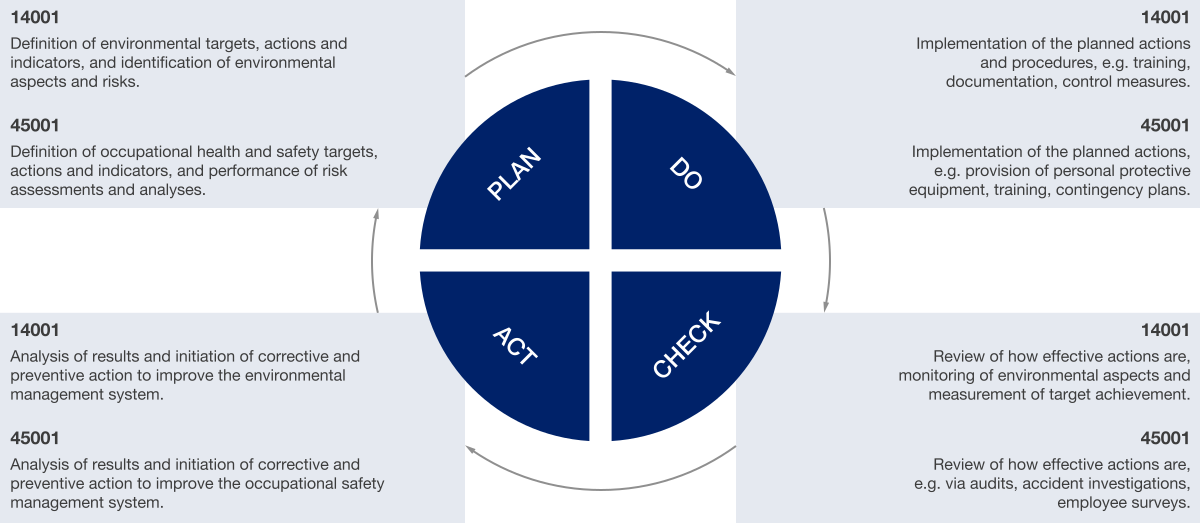
The HSE management system in line with ISO 14001 and ISO 45001 was introduced in the specified companies using the PDCA method (plan, do, check, act) and is thus subject to continuous improvement. This includes the assessment of risks and opportunities in relation to health, safety and environmental protection. This has led to the identification of internal and external issues relevant to HHLA which may affect its ability to achieve the intended outcomes of the HSE management system.
|
|
31.12.2025 |
||||
|---|---|---|---|---|---|---|
Own employees1 |
|
3 |
||||
External employees working in a HHLA company |
|
0 |
||||
|
||||||
HHLA strives for a long-term zero-accident ambition with the aim of continuously reducing the LTIR (lost time injury rate). The effectiveness of the actions is regularly reviewed through internal audits, trend analyses and comparisons against defined targets. If any deviations are identified, targeted corrective measures are adopted.
|
|
31.12.2025 |
||||
|---|---|---|---|---|---|---|
Number of reportable accidents at work |
|
196 |
||||
Rate of reportable work-related accident (accident rate) (LTIR) |
|
14.33 |
||||
|
||||||
Serious accidents at work are subject to standardised cause analyses involving the units concerned. Preventive actions derived from these analyses are implemented as a binding requirement. Typical follow-up actions include trainings, safety briefings and technical modifications.
Secure employment
HHLA sees secure employment as a central component of its corporate responsibility and as a cornerstone of sustainable added value. In a dynamic market environment dominated by technological and social changes, HHLA focuses on long-term employment prospects, fair working conditions and continuous training for its employees.
The overarching HR strategy for the Hamburg-based HHLA companies, particularly the “Employer of Choice” and “Co-determination” action areas, emphasises the importance of secure employment and a clear HR policy focus. In addition, the letter of intent signed in September 2025 strengthens the rights of employees at all HHLA locations and promotes Group-wide social partnership. The Head of Human Resources is responsible for implementing the human resources strategy in Hamburg. The Chief Human Resources Officer is responsible for implementing the Group-wide letter of intent to reinforce employee rights.
Social security for employees within the HHLA Group is based on collective agreements and the relevant national legislation in the countries in which HHLA operates. Regardless of where they are based, all employees enjoy social protection for key life events such as illness, unemployment, accidents at work and occupational incapacity, parental leave and retirement in accordance with the local statutory framework and standards. Coverage is provided either through public social security systems or through additional benefits provided by the company. The amount and duration of any payments depend on the national legislation and vary accordingly. Entitlement to the social benefits referred to above is generally linked to minimum lengths of service or minimum payments into social security funds. This applies, for example, to pension insurance.
Actions
The following measures were implemented in the reporting period to promote safe and fair employment conditions:
Sick pay supplement under the collective labour agreement for SCA (now: HHLA Container Technik GmbH) and SCB
As of 1 January 2026, employees who are unable to work due to illness will receive a sick pay supplement for up to six weeks. This compensates for the difference between the sick pay paid by health insurance and their previous net salary. The aim is to provide financial security during prolonged periods of illness. This does not apply to executives or trainees. The regulation applies until the labour agreement is terminated.
Regulations for CTX programmes
Several actions have been agreed for employees in companies headquartered in Hamburg, including:
Ban on compulsory redundancies
Grandfathering provisions
Training commitments
Permanent priority for employees affected by CTX with regard to vacancies within the Group
Scope of application:
HHLA, CTA, CTB, CTT, KTH, SCA (now: HHLA Container Technik GmbH), SCB, HCCR, PSG, FKZ, FMH, HVCC
Exceptions: management staff, working students and trainees
Duration: until 31 December 2036
In addition, employees of companies bound by collective agreements in Germany have access to the HHLA capital plan as an additional component of their retirement provision. It enables, for example, individual early retirement solutions or various options for lump-sum payouts in old age.
Objective
HHLA is aware of the importance of secure jobs for its employees. This is reflected in the Group-wide objective of workforce growth within a corridor of 0 % to 2 %. The development of the number of employees in the HHLA Group forms part of the performance-related remuneration paid to the Executive Board and is reviewed annually. As it seeks to achieve this objective, HHLA is focusing on innovative recruitment strategies and actions to further develop its employer brand.
The employment target was adopted by the Supervisory Board, which includes an equal number of employer and employee representatives. The Personnel Committee of the Supervisory Board, which also includes employee representatives, prepares the remuneration system for the Executive Board. The remuneration system was adopted on 22 March 2021 and applies to all current members of the Executive Board. Any changes to the system are reviewed by the Committee and submitted to the Supervisory Board and the Annual General Meeting for approval (Section 120a (1) of the German Stock Corporation Act [AktG]).
Headcount for the HHLA Group rose by 5.3 % to 7,269 employees in the reporting period. This metric comprises the total number of active employees in the HHLA Group as of the balance sheet date. Structure and composition of own workforce
Working time
Compliance with employees’ contractual working hours is an important factor in HHLA’s reputation as a reliable employer. Within the HHLA Group, standard working hours and overtime rules are generally governed by national legislation. Collective agreements and works council agreements also specify and enforce these statutory requirements.
In principle, the HHLA companies strive to avoid/minimise overtime. Nevertheless, HHLA’s business model requires a certain degree of flexibility in staff scheduling. In particular, blue-collar activities related to container handling and transport may be subject to deviations or delays in the work process due to external factors, such as ship delays or blocked routes, meaning that overtime is unavoidable despite forward-looking staff planning.
Actions
The following measures were implemented in the reporting period to ensure compliance with the agreed working hours:
Container segment in Hamburg
Works council agreement on increasing staff availability, i.e. on allowing employees to volunteer to swap days off for pay in order to increase staff availability.
HHLA social pay contract and modified collective wage agreement: cross-terminal work activities, i.e. instead of being reassigned at short notice to a shift that falls outside their normal working hours, employees will ideally work their scheduled shift at another terminal in Hamburg.
Adequate wages
As an employer, HHLA is committed to paying competitive salaries. HHLA takes national benchmarks into account when setting wages for all employees to ensure that they receive adequate pay. All HHLA employees receive adequate wages at the very least (the minimum wage stipulated by law or in the collective agreement).
Definitions and calculation methods
All employees of HHLA and its subsidiaries who were actively employed at the end of the reporting period and who belong to the groups of people defined in the introduction to this chapter were included in the benchmark calculation. Data is collected in a differentiated manner:
Central data availability: the relevant HR data can be accessed centrally from the database from the areas of the Group that have a direct connection to the SAP HCM system.
Decentralised data collection: in those parts of the Group that do not have a direct SAP HCM connection, the data is provided and evaluated by the individual companies on the basis of internal Group queries.
Comparability of remuneration data: The basic salary was used for the purposes of the comparative analysis. In Poland and Ukraine, bonus payments were also taken into account to ensure that the evaluation was consistent.
Actions
The collectively agreed remuneration structures of the subsidiaries are reviewed independently at regular intervals in accordance with the relevant industry standards and are adjusted as necessary to ensure that pay is competitive.
In the reporting period, Metrans Polonia and Metrans Rail Polonia introduced a new salary system that divides employees into junior, middle and senior specialists and managers, and introduces salary bands in line with this change.
In Hamburg, a group works council agreement on allowances was concluded to standardise the allowance system at the terminals.
Collective bargaining
Collective bargaining has a long tradition at HHLA, which is reflected in various sector and company wage agreements.
The vast majority of employees in Germany are covered by collective agreements. This means that their pay and working conditions are governed by these agreements. HHLA is a member company of Zentralverband der deutschen Seehafenbetriebe (ZDS) and UVHH (Unternehmensverband Hafen Hamburg e.V. (UVHH). In the reporting period, collective bargaining negotiations took place for the German seaports of the German port operators. Basic hourly wages were increased by 3.1 % from 1 August 2025. The labour agreement runs for a period of twelve months (1 August 2025 – 31 July 2026).
At an international level, there are collective bargaining partnerships with various local trade unions in Muuga (Estonia), Odessa (Ukraine), Trieste (Italy) and Ceska Trebova (Czech Republic).
HHLA does not interfere in trade union recruitment as a matter of principle. Trade union members and employee representatives are not discriminated against due to their activities. Collective bargaining with the unions is conducted in good faith.
|
|
Employees – EEA |
|
Employees – non-EEA countries |
||||||||
|---|---|---|---|---|---|---|---|---|---|---|---|---|
Coverage rate |
|
31.12.2025 |
|
31.12.2024 |
|
31.12.2025 |
|
31.12.2024 |
||||
0–19 % |
|
|
|
Czech Republic |
|
|
|
|
||||
20–39 % |
|
Czech Republic |
|
|
|
|
|
|
||||
40–59 % |
|
|
|
|
|
|
|
|
||||
60–79 % |
|
Germany |
|
Germany |
|
|
|
|
||||
80–100 % |
|
|
|
|
|
|
|
|
||||
|
||||||||||||
Work-life balance
The life-stage-oriented design of employees’ personal and working lives is an important tool for creating fair and transparent working conditions for our own workforce, helping to secure living standards and ensure that HHLA employees remain loyal to the company in the long term.
Across all hierarchy levels and employee groups, including shift workers, it is possible in Germany to work part-time so that employees can tailor their individual working hours to different life stages. HHLA employees based in Hamburg can also work remotely in accordance with the “Remote working” works council agreement. In addition to the statutory annual leave entitlement, HHLA grants its employees who are covered by collective agreements additional days off, e.g. for births, weddings, funerals or to care for relatives. Other German companies such as Survey Compass and iSAM AG also offer flexible arrangements governing working hours and places of work.
The terminal locations abroad, HHLA PLT Italy, Container Terminal Odessa and HHLA TK Estonia, also offer flexible working hours and remote working (where operationally feasible).
The METRANS Group has launched a programme to promote work-life balance, enabling flexible working hours and the option of working from home.
The following table provides an overview of the extent to which HHLA employees were entitled to leave for family reasons in the reporting period and made use of this entitlement.
In % |
|
31.12.2025 |
||||
|---|---|---|---|---|---|---|
Employees entitled to leave for family reasons |
|
99.9 % |
||||
thereof eligible employees who took leave for family reasons |
|
4.0 % |
||||
|
||||||
Actions
New measures to improve work-life balance came into force in the reporting period:
Flexitime system
Group works council agreement on flexitime for employees of HHLA, CTA, KTH, CTB, CTT, SCA (now HHLA Container Technik GmbH), HPSG, FKZ and FMH
Applies to employees with fixed working hours according to the labour or works council agreement and to trainees in these companies
Objective: make working hours more flexible without imposing any core working hours
Flexible room usage (desk sharing)
Works council agreement at the company’s headquarters in Hamburg
Regulates the use of flexible workstations at the company’s headquarters to accommodate the high proportion of remote working
Logistica Giuliana – leave and time off
Annual leave and time off in lieu are monitored regularly, namely every three months, without any fixed objectives being defined.