















Earnings position
HHLA’s performance data trended upwards in 2025. Container throughput was up 5.4 % year-on-year to 6,295 thousand TEU (previous year: 5,970 thousand TEU). The moderate growth at the three Hamburg terminals was primarily due to increased throughput volume from the Far East shipping region, particularly China, as well as South America, Africa, Australia, the Middle East and other European seaports. There was also strong growth in feeder traffic. By contrast, overseas traffic volume with the North America shipping region fell strongly.
The international terminals achieved strong volume growth. This was largely due to the scheduled strong increase in volumes at the multifunctional terminal HHLA PLT Italy. The resumption of seaborne handling at Container Terminal Odessa (CTO) in the third quarter of 2024 was also continued to a limited extent in the 2025 financial year.
Transport volumes rose year-on-year by 10.9 % to 1,982 thousand TEU (previous year: 1,787 thousand TEU). The increase is primarily attributable to a strong rise in rail transport. In addition to the acquisition of a majority stake in Roland Spedition GmbH in the second quarter of 2024, this trend was driven by significant increases in volumes for many key routes. Road transport was also significantly above the prior-year level.
Revenue
in € million
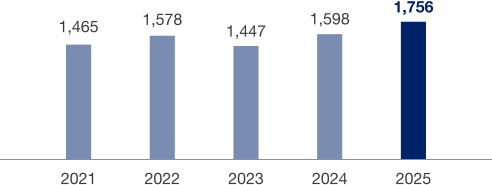
In the reporting period, the HHLA Group’s revenue rose by 9.9 % during to € 1,756.2 million (previous year: € 1,598.3 million). This was largely due to increased transport and throughput volumes. With its Container, Intermodal and Logistics segments, the listed Port Logistics subgroup developed almost exactly in line with the HHLA Group as a whole with revenue growth of 10.1 % to € 1,718.8 million (previous year: € 1,561.7 million). Revenue of the non-listed Real Estate subgroup increased by 0.5 % to € 46.3 million (previous year: € 46.1 million). The Real Estate subgroup thus accounted for 2.1 % of Group revenue.
In the reporting period, changes in inventories amounted to € - 3.0 million (previous year: € 0.3 million). Own work capitalised increased to € 10.3 million (previous year: € 7.7 million).
Other operating income decreased by 2.3 % to € 70.9 million (previous year: € 72.6 million). This figure includes income recognised in connection with the O’Swaldkai restructuring, mainly in connection with the extension of the lease and the transfer of real estate. In the previous year, this included reimbursement claims against HGV arising from the business combination agreement concluded in connection with the MSC transaction.
Expense structure
Operating expenses in 2025: € 1,674 million
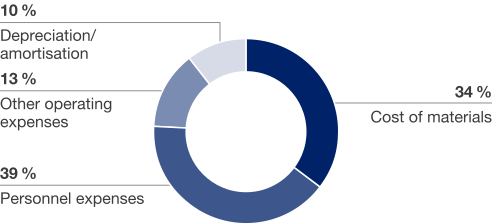
Operating expenses increased significantly by 8.4 % to € 1,673.9 million (previous year: € 1,544.6 million). This was due to the strong increase in personnel expenses and a significant rise in the cost of materials.
The cost of materials rose year-on-year by 7.0 % to € 595.3 million (previous year: € 556.6 million). This strong increase was attributable to the growth in volume of material-intensive rail traffic. The cost of materials ratio fell to 33.9 % (previous year: 34.8 %).
Personnel expenses rose by 14.3 % to € 683.8 million (previous year: € 598.3 million). The main reasons for this increase were increased union wage rates, the positive development of volumes with correspondingly high capacity utilisation, as well as the expansion of business in rail transport. The personnel expense ratio rose to 38.9 % (previous year: 37.4 %). In the previous year, a full reversal of non-contractually fixed restructuring provisions of € 18.8 million in the Container segment had a positive effect on personnel expenses.
Other operating expenses increased by 1.7 % during the reporting year to € 218.7 million (previous year: € 214.9 million). This was partly due to higher expenses for consultancy, property taxes in the real estate business and maintenance. The ratio of expenses to revenue amounted to 12.5 % (previous year: 13.4 %). In the previous year, this figure included provisions for property transfer tax formed on conclusion of the MSC transaction.
Against the backdrop of these developments, earnings before depreciation and amortisation (EBITDA) rose by 8.9 % to € 336.6 million (previous year: € 309.0 million). The EBITDA margin of 19.2 % was on a par with the previous year (previous year: 19.3 %).
Depreciation and amortisation increased slightly by 0.8 % year-on-year and amounted to € 176.2 million (previous year: € 174.8 million). The increase was due to necessary investments in the container terminals.
Operating result (EBIT)
in € million, EBIT margin in %
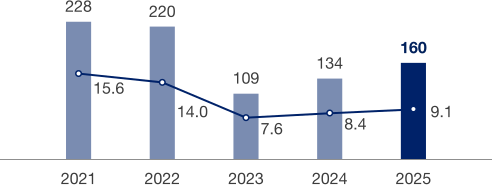
The operating result (EBIT) rose by 19.5 % to € 160.5 million in the reporting year (previous year: € 134.3 million), mainly due to the improved revenue trend. The EBIT margin also increased to 9.1 % (previous year: 8.4 %). In the Port Logistics subgroup, EBIT was up 22.8 % to € 144.7 million (previous year: € 117.8 million) and thus accounted for 90.2 % of the Group’s operating result (previous year: 87.7 %). In the Real Estate subgroup, EBIT decreased by 4.4 % to € 15.4 million (previous year: € 16.1 million) and accounted for 9.8 % of the Group’s operating result (previous year: 12.3 %).
Net expenses from financial income increased by € 11.8 million, or 27.2 %, to € 55.0 million (previous year: € 43.3 million). This change was mainly due to increased interest expenses on bank liabilities.
At 69.9 %, the Group’s effective tax rate was significantly above the prior-year level (previous year: 38.0 %). The increase in the tax rate was mainly due to two effects: firstly, as at 31 December 2025, deferred tax assets on tax loss carry-forwards were impaired due to earnings expectations that were downgraded in light of the current developments. Secondly, the new tax rates arising from the law passed in 2025 to promote investments were taken into account in the measurement of deferred taxes as of 31 December 2025.
The proportion of consolidated net income attributable to the parent company’s shareholders decreased by 70.0 % year-on-year to € 9.8 million (previous year: € 32.5 million). Non-controlling interests accounted for € 21.9 million in the 2025 financial year (previous year: € 23.9 million). Earnings per share decreased by 70.0 % to € 0.13 (previous year: € 0.43). The listed Port Logistics subgroup posted a 95.1 % decline in earnings per share to € 0.02 (previous year: € 0.32). Earnings per share for the non-listed Real Estate subgroup were down on the prior year’s figure at € 3.20 (previous year: € 3.52). As in the previous year, there was no difference between basic and diluted earnings per share in 2025.
The return on capital employed (ROCE) was up 0.5 percentage points year-on-year at 5.9 % (previous year: 5.4 %). Corporate and value management
HHLA’s appropriation of profits is oriented towards the development of the HHLA Group’s earnings in the financial year ended. On this basis, the Executive Board and Supervisory Board will recommend to the Annual General Meeting that no dividend be paid for listed class A shares or for non-listed class S shares in the 2025 financial year. In the previous year, the dividend payout for class A shares amounted to € 7.3 million (€ 0.10 per class A share) and € 4.1 million for class S shares (€ 1.50 per class S share).