









Management of impacts, risks and opportunities
Management of impacts, risks and opportunities related to climate change mitigation and climate change adaptation
HHLA addresses the following topics as part of its management approach to balanced logistics, as described below:
-
Climate change mitigation
-
Energy efficiency
-
Use of renewable energy
To manage the material climate and energy-related impacts, risks and opportunities, HHLA has firmly established the “Climate protection and energy efficiency” and “Climate-friendly logistics chain” areas of action in its “Balanced Logistics” sustainability strategy.
In order to effectively mitigate climate change, HHLA focuses on lowering its absolute level of carbon dioxide equivalent emissions (CO2eq). By steadily increasing its energy efficiency and the proportion of renewables in its energy mix, HHLA aims to decouple handling and transport volumes on the one hand and CO2eq emissions on the other.
For substantial CO2eq reductions, HHLA aims to electrify more of its equipment and machinery at the terminals, thus substituting fossil fuels with renewables. This not only means that terminals produce fewer emissions and less noise, the alternative handling equipment is also easier to service. These technologies not only lower emissions locally but offer economic benefits, which are becoming increasingly important as energy prices rise.
The planned further expansion of the intermodal network will facilitate low-carbon goods transportation. HHLA's handling and transport services enable users of these services to transport their own goods while producing low or zero emissions, reducing their Scope 3 emissions in the process.
The climate strategy and, consequently, also the “Climate protection and energy efficiency” and “Climate-friendly logistics chains” action areas apply across the entire Group. Responsibility for climate change mitigation and consequently for Balanced Logistics lies with the Chief Executive Officer of HHLA.
Targets related to climate change mitigation
As part of its “Balanced Logistics” sustainability strategy and the “Climate-friendly logistics chains” and "Climate protection and energy efficiency” areas of action, HHLA has set itself the following combined objectives:
-
Reduce absolute Scope 1 and 2 CO2eq emissions by at least 50 % by 2030 (2018 base year)
-
Climate neutrality for Scope 1 and 2 by 2040
(HHLA is deemed to be climate-neutral if at least 90 % of its Scope 1 and 2 emissions (market-based) have been reduced to zero and the remaining emissions are compensated by means of carbon capture or high-quality offset schemes.)
The climate target applies across the Group and covers all HHLA locations and segments, as well as all fully consolidated subsidiaries plus HVCC, KTH, FKZ and Ulrich Stein.
The objective covers HHLA's combined Scope 1 and Scope 2 CO2 emissions. All greenhouse gases covered by the Kyoto Protocol are included in the assessment.
The baseline value for the Scope 2 emissions is the market-based emissions value. Consistency of the defined targets with the greenhouse gas inventory is ensured through annual internal reviews and reporting. Target achievement is monitored by the Sustainability Staff Department on an ongoing basis and is documented in the annual emissions report. Corporate management declaration
This means that the targets for Scope 1 and 2 emissions are consistent with the Paris Agreement to limit global warming to 1.5°C.
The decarbonisation levers in the value chain primarily focus on the use of alternative propulsion technologies for downstream first- and last-mile freight transport. HHLA expanded its emissions reporting in the reporting period to include material Scope 3 emissions. Gross Scope 1, 2 and 3 GHG emissions and total GHG emissions
HHLA is focusing on reducing absolute greenhouse gas emissions and increasing the share of rail transport in order to respond effectively to the impacts listed in the Material impacts, risks and opportunities table and thus help to limit global warming. The greenhouse gases emitted by the HHLA Group (Scope 1 and 2) are generated primarily by the operation of vehicles and handling equipment. The volume of emissions is influenced in particular by the type of drive technology and fuel used, as well as by the proportion of electricity sourced from renewable energies and the degree of energy efficiency. Detailed information on actions developed on this basis can be found in the section Actions and resources related to climate change mitigation and adaptation
Reliance on technological advances and the market ramp-up of alternative propulsion technologies, however, means that the implementation of electrification measures is largely influenced by the solutions that manufacturers have to offer. As a result, the decarbonisation levers were geared primarily towards technological availability and market development.
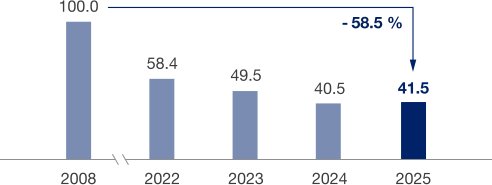
Trends in specific CO2eq emissions
Specific CO2eq emissions compared with 2008 in %
In the reporting period, the company was responsible for 94,164 tonnes of CO2eq in Scope 1 and market-based Scope 2 emissions; this is equal to a reduction of 4.5 % compared to the previous year. All in all, emissions have been reduced by 44.7 % since the base year 2018. This means that HHLA is on track to achieve its climate targets and confirms the positive reduction trend seen in recent years.
Two developments in particular had an effect on the level of CO2eq emissions in 2025:
Switch in electricity procurement: the electricity supply for the multi-purpose terminal in Trieste and for Metrans Polonia was switched over to renewable energy sources.
Diesel consumption: growth in handling at the container terminals Tollerort (CTT) and Burchardkai (CTB) as well as at the multi-purpose terminal in Trieste led to higher diesel consumption.
The specific CO2eq emissions rose slightly by 1.0 percent in comparison to the previous year and are thus 58.5 % below the level in the base year 2018.
Actions and resources related to climate change mitigation and adaptation
The following actions were implemented and planned during the financial year in order to achieve HHLA’s objectives.
Electrification of handling processes: a further storage block with three electrically powered stacking cranes was put into operation at Container Terminal Burchardkai (CTB) in 2025. There was further progress on introducing battery-powered AGVs, which will replace diesel-powered straddle carriers in future.
Use of alternative fuels: biodiesel (HVO) is being used in a variety of equipment at Unikai.
Preparations have been made for the trial use of biodiesel (HVO) at the Container Terminal Tollerort (CTT).
The main levers used to reduce CO2 emissions include the electrification of operating processes, the use of renewable energies and the use of alternative fuels.
Climate change adaptation
With regard to the material physical climate risks, there are actions that have already been implemented, actions that were continued in the financial year and actions that are planned for the future, with all actions being reviewed at least once a year to ensure they are still appropriate and effective.
The most important actions implemented in the reporting year in relation to climate change adaptation are:
Insurance: extensive insurance continues to cover physical damage to the company’s facilities and goods caused by flooding. This applies to the Hamburg terminals and the METRANS Group locations that operate close to water.
Adjustments to flood protection systems: the design of flood protection systems is reviewed on an ongoing basis and, where possible, the systems are adjusted to reflect new findings so that they provide continuous protection in accordance with flood levels. This applies to the Hamburg terminals and Fischmarkt Hamburg, as well as the METRANS Group locations that operate close to water. The flood protection systems in Hamburg's Speicherstadt historical warehouse district are being continuously expanded as part of upgrading projects.
Adjustments to operating processes: HHLA cannot mitigate disruptions or route closures in the value chain by making active physical changes. Effective actions are based on flexible operating processes, ensured by the availability of skilled staff and appropriate expertise, together with sufficient equipment to utilise alternative routes. This applies to the business activities of the METRANS Group and Roland Spedition.
Electrification
More than 90 % of HHLA’s Scope 1 emissions caused by the use of fossil fuels arise from combustion in the mobile vehicles and equipment used to transport containers. The aim is to continuously increase energy efficiency, the degree of electrification and the share of renewable energies in HHLA’s energy mix by increasing the volume of electricity purchased from renewable energy sources and expanding the company’s own electricity production. Depending on the technology available, the company can use vehicles that run without fossil fuels or on alternative fuels. The aim is to decouple handling and transport volumes from carbon emissions so that renewable energies can provide almost all the energy used. Between now and 2040, the carbon emissions generated from freight transport and handling should therefore decline on an ongoing basis, ultimately resulting in a CO2eq reduction of 90 % compared to the base year for Scopes 1 and 2.
In the reporting period, the proportion of renewables in overall energy consumption stood at 64.3 % (previous year: 64.9 %). In 2018, the base year for the climate change mitigation target, this stood at 48.9 %.
In rail freight transport, the electrification of the relevant routes is a prerequisite for the use of electrically powered long-distance locomotives. The current use of diesel-powered locomotives is largely limited to a handful of diesel-powered long-distance locomotives and diesel-powered shunting locomotives, which cannot be replaced by electric locomotives due to a lack of electrification on the routes used or because installing overhead lines at the terminals is not technically feasible.
Energy efficiency
The effectiveness of the existing energy management system, certified according to DIN ISO 50001:2018 and covering all HHLA companies with significant energy consumption in Germany, was reaffirmed by a review audit during the reporting period.
Use of alternative fuels
The vast majority of combustion-engined vehicles and equipment that HHLA uses as part of its business model will be replaced before 2040 due to the end of their service lives. Depending on the technology available, the company can then use vehicles that run without fossil fuels.
Use of renewable energy in the company’s own operations
By 2032, HHLA aims to cover the electricity demand associated with its business activities using only renewable energy. In the reporting period, 73.1% of electricity consumption came from renewable sources, up from 70.2 % in the previous year.