














Market position
With its listed core business Port Logistics, HHLA competes with other companies on the European market for sea freight services. By establishing locations for handling activities both in the Mediterranean and Baltic regions, as well as continuously optimising and expanding its intermodal network, HHLA has been able to leverage the growth potential of its respective markets over recent years. In the 2025 financial year, however, growth in the HHLA Group was affected by the ongoing weakness of the German economy, the significant increase in global economic uncertainty – due in particular to US trade policy and its impact on supply chains – and the resulting ongoing disruptions to the global flow of goods. Economic environment
Container segment
Competitive factors
The competitive position of a terminal operator is determined by geographical location and the hinterland links of a port as well as its accessibility from the sea. Local freight volume in the direct catchment area of each port location also plays an important role. Other key competitive factors that influence the market position include the reliability and speed of ship handling as well as the scope and quality of services, Also of increasing importance is the performance of pre- and onward-carriage rail systems between the port and its hinterland (for example, in terms of frequency, punctuality and pricing) and therefore the range of integrated transport solutions.
Competition is extremely fierce in Northern Europe and ports are still being affected by changing shipping company constellations, alliances and participations in terminals. Business partners and clients
With regard to the potential transfer of container traffic, a distinction must be made here between overseas traffic (i.e. ocean transport from distant regions, such as Asia or North America, to Northern Europe) and feeder traffic, which redistributes cargo from the major North Range seaports to the Baltic, for example. The shifts resulting from new shipping company constellations, alliances and participations in terminals towards more geographically flexible feeder traffic is having an impact on handling volumes. By contrast, handling volumes of overseas traffic that are tied to the port’s natural catchment area are relocated less frequently. Competition in maritime hinterland transport by rail or truck is becoming more intensive, not least as a result of shipping companies entering the market through horizontal business field strategies.
Competitive environment
The market for port services of significance to HHLA on the Northern European coast (the North Range) is characterised by its high concentration of ports. Competition is particularly strong between the four largest North Range ports of Rotterdam, Antwerp-Bruges, Hamburg (HHLA’s main hub) and the Bremen ports.
Container throughput at the North Range ports
Handling volumes and market shares 1–9 | 2025
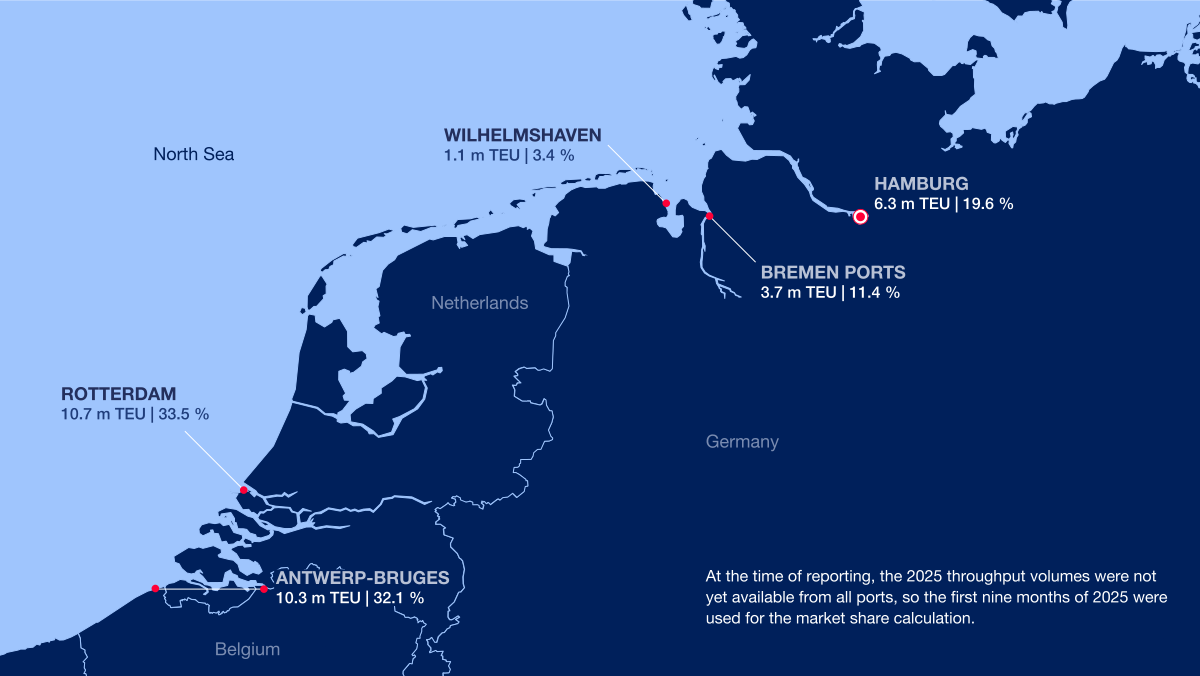
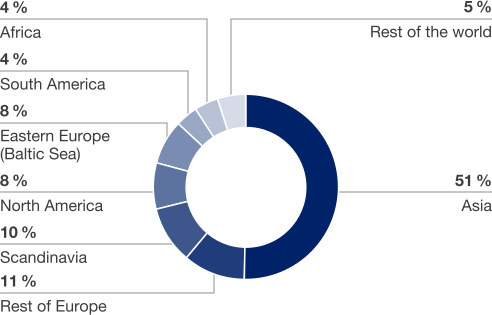
As the most easterly North Sea port, the Port of Hamburg’s position makes it the ideal hub for the entire Baltic region and for hinterland traffic to and from Central and Eastern Europe. Furthermore, the long-standing trading relationships between the Port of Hamburg and the Asian markets are advancing Hamburg’s role as a major European container hub. With container throughput of 8.3 million TEU, the Port of Hamburg is expected to rank 24th in the world in 2025, cementing its status as the third-largest European container port after Rotterdam and Antwerp-Bruges. In the Port of Hamburg, HHLA is a direct competitor of Eurogate, particularly with regard to overseas services: HHLA operates three container terminals in Hamburg, while Eurogate operates one. With a throughput volume of 6.1 million TEU in the 2025 financial year, HHLA remained the largest container handling company in the Port of Hamburg with a market share of 72.9 % (previous year: 74.8 %). The major shipping regions were Asia, North America, Scandinavia and the Baltic region, as well as the other European routes.
Container throughput at the North Range ports
in million TEU
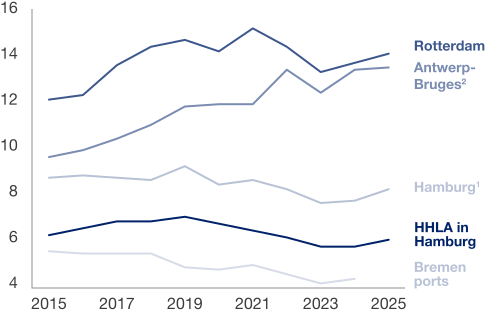
1 incl. HHLA,
2 incl. Zeebrügge since 2022
Container throughput by shipping region
in the Port of Hamburg in 2025
The Baltic Sea ports are primarily served by feeder traffic operating via the central distribution points in the North Range. At the same time, ports such as Gdansk and Gothenburg are also used by ocean-going vessels. The Port of Gdansk in particular has become a serious competitor within this network system. The Polish ports recorded strong growth of 19.2 % in the first nine months of 2025, with Gdansk accounting for the lion’s share. With additional terminal capacity going online via Baltic Hub 3, this upwards trend looks set to continue.
With HHLA TK Estonia, HHLA has been operating one of Estonia’s most important multifunctional terminals in the Port of Muuga near Tallinn since 2018. Due to the wide range of services, including container handling and the processing of RoRo traffic, as well as general cargo and bulk cargo, the terminal is highly diversified. Furthermore, the Port of Muuga is part of the Trans-European Transport Network (TEN-T), which includes rail routes, inland waterways, shorter seaborne routes and roads. Various feeder services called at the terminal in the 2025 financial year, operated both by commercial feeder companies and overseas shipping companies.
The Adriatic region with ports such as Koper and Trieste has also developed dynamically in recent years. Having acquired a majority shareholding in the multifunctional terminal Piattaforma Logistica Trieste (PLT) in Trieste in 2021, HHLA has positioned itself in a market that offers good opportunities for development, including the opportunity to actively participate in and help shape new and changing cargo flows. The terminal has its own rail connection. The Port of Trieste is also integrated into the European intermodal network of HHLA’s rail subsidiary METRANS. A weekly container service currently calls at the terminal, with additional, irregular calls by customers.
The Container Terminal Odessa (CTO) on the Black Sea is Ukraine’s largest container terminal. It has been operated by the HHLA Group since 2001 and previously handled bulk cargo, general cargo and project cargo in addition to containers. With the outbreak of the war in Ukraine in February 2022, seaborne container handling at the CTO was suspended by the authorities. All that was possible was the partial loading of grain ships to comply with international agreements. Seaborne handling, however, resumed in the third quarter of 2024 and was continued to a limited extent during the 2025 financial year. Given the ongoing geopolitical instability and restricted business operations, it remains difficult to assess the market environment.
Intermodal segment
Competitive factors
In addition to the density of the available network, key competitive factors for intermodal transport – which is becoming increasingly significant in terms of the competition between ports – include the frequency of departures, opportunities for freight pooling and storage in the hinterland, the geographical distance to destinations, punctuality and infrastructural capacity.
Competitive environment
With regard to container transport by train, the state railway companies compete with a variety of private rail operators and intermodal transport firms, as well as with other carriers such as trucks and barges or feeder ships. As rail infrastructure is mainly publicly owned, various national authorities guard against discrimination in terms of both access and usage fees.
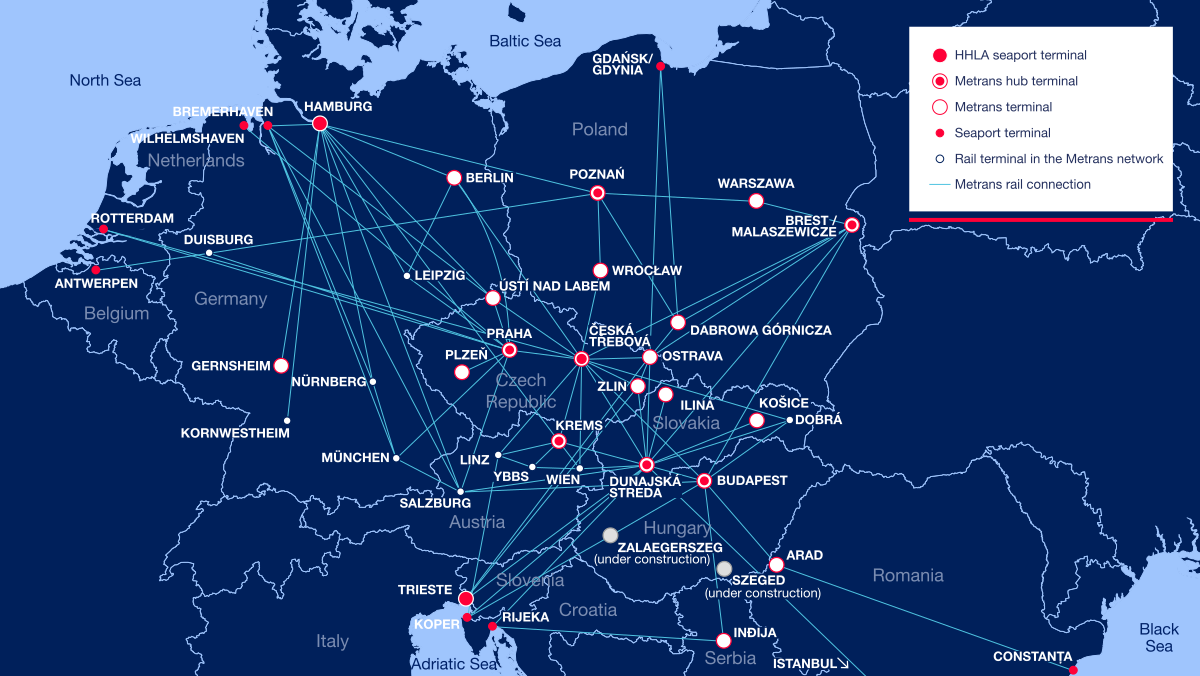
HHLA operates proprietary inland terminals in Central and Eastern Europe along with its own container wagons and traction fleet (via locomotives), all of which are central to the company’s service offering. This is necessary to enable HHLA to run direct trains with frequent and highly punctual departures. HHLA occupies relevant market positions in the majority of the regions it serves in the field of intermodal transport. In the Hamburg Metropolitan Region, HHLA has a sound market position in the delivery and collection of containers by truck.
Intermodal network of HHLA
Selected connections
Logistics segment
The Logistics segment serves various market sectors, some of which are highly specialised. With its multifunctional terminal Unikai, HHLA is the leading provider of specialist handling services in Hamburg. With its equity holding in Hansaport, HHLA has a stake in Germany’s biggest seaport terminal for handling iron ore and coal. HHLA also provides fruit handling services for Northern Europe at its Frucht- und Kühl-Zentrum. The portfolio also includes consulting and management services for clients in the international port and transport industry. Business activities for process automation, digital services and leasing services, particularly for the Intermodal segment, complete the portfolio.
Real Estate segment
As a significant economic centre with a population of approximately 1.9 million, Hamburg is one of the largest property markets in Germany for the non-listed Real Estate segment. What makes its property portfolio particularly attractive are its unique buildings and favourable locations in Hamburg’s Speicherstadt historical warehouse district and on the northern banks of the river Elbe/fish market area. The company has built up a wealth of development and implementation expertise dedicated to finding the right balance between market orientation and the careful handling of its landmarked buildings with world heritage status. Here, HHLA competes with German and international investors marketing premium commercial properties in comparable locations.