









Intermodal segment
in € million |
|
2025 |
|
2024 |
|
Change |
|---|---|---|---|---|---|---|
Revenue |
|
797.0 |
|
711.3 |
|
12.0 % |
EBITDA |
|
151.5 |
|
135.0 |
|
12.3 % |
EBITDA margin in % |
|
19.0 |
|
19.0 |
|
0.0 pp |
EBIT |
|
103.7 |
|
83.7 |
|
23.9 % |
EBIT margin in % |
|
13.0 |
|
11.8 |
|
1.2 pp |
Container transport in thousand TEU |
|
1,982 |
|
1,787 |
|
10.9 % |
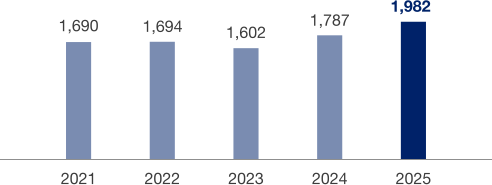
In the highly competitive market for container traffic in the hinterland of major seaports, HHLA’s transport companies recorded a strong increase in volume in 2025. Container transport increased by 10.9 % to 1,982 thousand standard containers (TEU) (previous year: 1,787 thousand TEU).
Rail transport rose by 11.2 % year-on-year to 1,719 thousand TEU (previous year: 1,545 thousand TEU). This strong volume growth was largely due to traffic with the North German seaports, as well as traffic in the German-speaking countries. Moreover, the transport volumes of Roland Spedition in the previous year were only included from June onwards.
Container transport
in thousand TEU
Road transport rose significantly by 8.7 % to 263 thousand TEU (previous year: 242 thousand TEU). The recovery in transport volume in the Hamburg region in particular contributed to this development.
With a year-on-year increase of 12.0 % to € 797.0 million (previous year: € 711.3 million), revenue growth was stronger than the rise in transport volumes. In addition to necessary price adjustments, this was partly due to the further increase in rail’s share of HHLA’s total intermodal transport volumes from 86.5 % to 86.7 %.
The operating result (EBIT) amounted to € 103.7 million in the reporting period (previous year: € 83.7 million), and was thus 23.9 % up on the previous year. The EBIT margin rose by 1.2 percentage points to 13.0 % (previous year: 11.8 %). The main reason for this strong EBIT growth was the increase in transport volumes. There was an opposing effect from ongoing operational difficulties caused by construction work on major transport routes and congestion at the North German seaports.
HHLA continues to invest as needed in the expansion of its intermodal network. The decrease in route prices for German rail freight applied in mid-2018 is bolstering the development of the intermodal service portfolio. HHLA’s rail subsidiary METRANS put eight new multi-system locomotives into operation during 2025. It now has approximately 190 shunters and locomotives, as well as a fleet of over 4,100 container wagons. The network consists of 20 terminals in the hinterland, of which five serve as large hub terminals.