










Management of impacts, risks and opportunities
Principles and standards
Social sustainability for HHLA’s own workforce is determined by the corporate and sustainability strategy adopted by the Executive Board in addition to the applicable legislation. Strategy and management/Corporate and sustainability strategy
In addition to the continued further development of our core business and the development of new growth fields, sustainability is an integral component of HHLA’s business model. HHLA has defined nine action areas with corresponding guidelines for its sustainability activities. With regard to the company’s own workforce, these include, in particular, the “Working World” and “Occupational health and safety” areas, with guidelines on initial and further training featuring customised support for employees, together with ensuring safe and fair working conditions and health-conscious behaviour. The sustainability indicators were selected based on HHLA’s corporate and sustainability strategy. The “Employees (headcount)” metric in the ”Working World” area is managed with a view to maintaining the number of employees across the Group. HHLA is focusing on two measures to achieve this objective: first, the expansion and targeted exploitation of growth opportunities in the intermodal business and, second, exploiting the growth potential of new digital business models.
Moreover, HHLA encourages worker co-determination across the Group and safeguards both the freedom of association and the right to collective bargaining.
As a responsible company, HHLA is committed to observing and adhering to human rights. HHLA’s activities are guided by the United Nations Universal Declaration of Human Rights (UDHR) and the United Nations’ Guiding Principles on Business and Human Rights (UNGP). Additional international standards and agreements such as the United Nations Global Compact (UNGC) and the International Labour Organization’s core labour standards (ILO) are also fundamental to HHLA’s activities and corporate culture.
In line with these standards, the HHLA Code of Conduct, the compliance guidelines, the anti-corruption guidelines, the competition guidelines and the guidelines for the verification of business partners set out mandatory ground rules for HHLA’s activities, thereby helping to ensure that internationally recognised human rights are respected and observed. The key aspects of the Code of Conduct include sustainability and environmental protection, occupational health and safety, corruption prevention, respect for diversity and condemnation of all forms of discrimination. HHLA expects its employees to abide by all applicable laws and, as a result, also the fundamental principles of human rights. To maintain awareness among all employees, regular trainings are held on the Code of Conduct, corruption prevention and other human rights-related issues such as occupational health and safety.
HHLA investigates every report of a possible human rights violation in accordance with the internal regulations on the procedure for reports of compliance violations (cf. compliance guidelines). Remediation is assessed and implemented on a case-by-case basis, depending on the specific breach; this may lead to the suspension or termination of business relationships. The effectiveness of the measures put in place is evaluated as required, and at least once per year, to ensure continuous improvement. This also includes critically reviewing existing processes and modifying them as required.
The Compliance Department reports on identified risks and countermeasures every year and evaluates how effective they are. Based on these evaluations, conclusions are drawn for the benefit of future activities. Any human rights violations or cases of discrimination can be reported anonymously via a digital whistleblower portal.
Both the HHLA Code of Conduct and the Declaration of Principles are available online at www.hhla.de/en/company/compliance and on the intranet (HHLA Inside). The Code of Conduct is also posted as a notice on company premises.
The workforce’s views on this topic are taken into account when designing new trainings for blue-collar employees, among other things. For example, HHLA Technical College employees, most of whom are also employees of HHLA companies, help develop the focus areas covered by trainings. The emphasis is on the practical relevance of the topics for employees. HHLA does not evaluate the effectiveness of cooperation with its own workforce.
The policies and internal guidelines introduced by HHLA, in particular the HHLA Organisational Manual, including the HHLA Code of Conduct, and the ongoing monitoring processes help the company to minimise potential adverse impacts on its own workforce, including in situations where there is a clash between commercial and social interests.
HHLA helps to ensure that sufficient resources are available to manage material impacts effectively by providing human resources for specialised teams and by investing in technology and infrastructure. All HHLA companies are obliged to appoint compliance and data protection officers and to support them by providing the necessary resources and training. HHLA’s headquarters are also home to the Internal Audit, Sustainability/Energy Management, Diversity & Inclusion and Occupational Health & Safety Management Staff Departments. These address the key issues related to the company’s own workforce and act as coordinators for the Group as a whole. They all report directly to the Executive Board and, in some cases, directly to the Supervisory Board as well. HHLA’s Supervisory Board also includes employee representatives.
Strategic framework
Responsibility for HR management is established at Executive Board level, from which it is managed as a central division. This organisational structure ensures that strategic HR guidelines can also be implemented throughout the Group.
In general, it is the responsibility of each subsidiary to structure its own HR work in line with HHLA’s corporate and sustainability strategy so that its activities reflect local and operational conditions to the greatest extent possible.
In line with this approach, the subsidiaries HHLA PLT Italy, iSAM AG and Survey Compass have developed their own HR policies. There is also an overarching HR strategy for the HHLA companies at the Hamburg location.
Companies at the Hamburg location which are subject to an overarching HR strategy
HHLA Container Terminal Burchardkai (CTB)
Service Center Burchardkai (SCB)
HCCR Gesellschaft mbH (HCCR)
HHLA Container Terminal Tollerort (CTT)
HHLA Container Terminal Altenwerder (CTA)
HHLA Container Technik (previously: SCA Service Center Altenwerder)
HVCC Hamburg Vessel Coordination Center (HVCC)
HHLA International (HIG)
HHLA-Personal-Service (PSG)
CTD Container-Transport-Dienst (CTD)
omoqo
heyport
passify
HHLA Sky
HHLA Next
HHLA Frucht- und Kühl-Zentrum (FKZ)
UNIKAI
Ulrich Stein
HPC Hamburg Port Consulting (HPC)
RailSync
hubload
Fischmarkt Hamburg-Altona (FMH)
Fostering the skills and engagement of all employees represents a key pillar of sustainable success at HHLA. The HR strategy of the German HHLA companies comprises five action fields: “Employer of Choice”, “Develop Further”, “Work Together”, “Resource Management” and “Co-Determination”. The fields of activity are based on the human resources end-to-end processes:
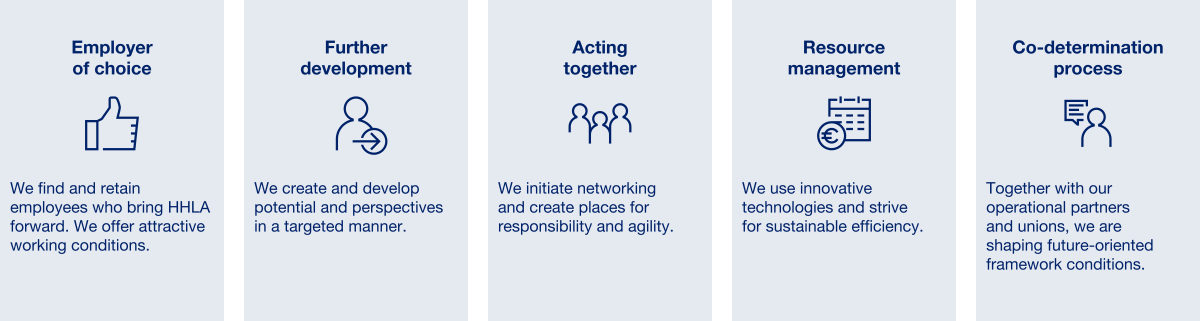
In Hamburg, the strategic focus of this concept is both on a strong employer brand through attractive working conditions and on targeted personnel development that equips HHLA employees with the skills they need to meet the current and future challenges associated with their work (“Fit for tomorrow’s world”) and promotes structural networking and a connective corporate culture. Participation-oriented co-determination processes are also to be further developed in cooperation with co-determination partners, managers and employees, in order to shape the future-oriented framework for HHLA’s success as an enterprise. Moreover, existing resources in HR are to be optimally aligned in future with the aid of innovative technologies, methods and policies, and the range of services offered is to be continuously expanded. The Head of Human Resources is responsible for implementing the human resources strategy in Hamburg.
HHLA and the European Transport Workers’ Federation (ETF) signed a letter of intent in September 2025 that strengthens employee rights across the Group. This is based on protective provisions from the Business Combination Agreement (BCA), which now also apply to the company’s international locations. Under the BCA, the HHLA shareholders undertake not to introduce or initiate measures for at least five years, starting from 21 November 2024, which are aimed at amending or terminating existing works council agreements, collective agreements or similar agreements within HHLA, particularly in relation to working conditions. They also undertake not to initiate any action that would result in redundancies within HHLA or its group companies, with the exception of those already agreed within the HHLA Group and/or with its members.
In the letter of intent, HHLA also makes a commitment to constructive social partnership at all of its companies. The agreement promotes open communication, transparency and regular dialogue between management and employee representatives. The fundamental principles of cooperation are based on: open communication through transparent information channels and regular dialogue with employee representatives, ensuring the well-being of employees during all change processes, involving employee representatives in relevant decision-making processes, and promoting training and development programmes to give HHLA employees the skills they need to meet new requirements. The Chief Human Resources Officer is responsible for implementing this letter of intent.