
Procurement and supplier management
Remit and strategic objectives
HHLA Group Procurement is firmly established as a strategic partner within the Group. It is involved in procurement projects at an early stage, providing value-adding support. Purchasing is a shared service provided by the Group’s management holding company in Hamburg and deals with procurement activities on behalf of most of its domestic majority holdings. It also supports and advises Group companies as part of its holistic management of product groups, suppliers and contracts so that the service and performance requirements of internal customers are met as fully as possible.
For international shareholdings attributed to HHLA International GmbH, Purchasing also handles the procurement of large-scale equipment, which means that supplier management for strategic suppliers is organised in an efficient, centralised way.
Pioneering solutions are developed for the Group in close partnership with Operations and Engineering. In the process, HHLA draws on strategic and cooperative collaborations with select business partners. The aim is to establish a consolidated supplier base characterised by innovation, maximum added value, top quality and optimum life cycle costs. In addition to economic aspects, great importance is attached to sustainable procurement, which begins with the careful selection of suppliers. In the supplier qualification process, suppliers submit a self-disclosure confirming that they fulfil the quality standards of HHLA in the fields of sustainability, compliance, procurement and occupational health and safety.
Product groups and volumes
Procurement volumes
in the HHLA Group in 2025: € 337.2 million
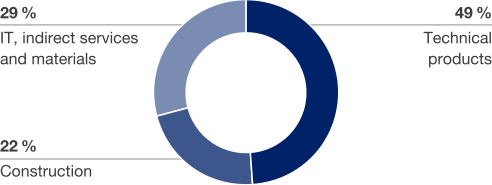
The procurement volume of € 337.2 million falling under the central responsibility of the HHLA Group in 2025 (previous year: € 436.7 million) was distributed between the above-mentioned groups. In the past three years, the proportion of capital expenditure was much higher than the average for the previous years, which is why the procurement volume remains high. Purchasing covers a wide range of procurements, distributed between three main product groups: technical purchasing, construction purchasing, information technology (IT) and indirect purchasing. Technical purchasing deals with the procurement of port handling equipment and energy products and covers the procurement of materials as well as services needed to service and maintain terminals and technical components. The construction department is responsible for the product groups of construction above and below ground, railway construction and facility management. In addition to project management services, these areas also include planning and engineering services as well as maintenance and repair services. The main items procured by the IT and indirect purchasing department include software, hardware and telecommunication products, as well as services such as consultancy, marketing and HR services. The department also handles the procurement of office materials and personal protective equipment.
Selection of suppliers and service providers
When selecting partners, great importance is attached to sustainability and compliance as well as financial stability, quality, reliability and innovative flair. HHLA requires its suppliers and service providers to comply with its Supplier Code of Conduct, which covers the aspects of human rights, occupational health and safety, environmental protection and sustainability as well as appropriate conduct in a business environment. It is published in the relevant section of the HHLA website. HHLA Supplier Code of Conduct Compliance with HHLA’s sustainability standards plays a major role in minimising risks.
During the reporting year, nearly 96.0 % of the procurement volume was placed with suppliers who had pledged to comply with the regulations, or with similar regulations.
Another element of the supplier and risk management strategy is business partner screening which, for example, makes it possible to regularly check entries in various sanctions lists. Compliance with these criteria is monitored by an IT-based supplier management system. This also facilitates a continual review of the degree of fulfilment and the supplier base.
In the reporting period, the procurement volume was divided between 1,925 active suppliers. 32.1 % of the volume was placed with suppliers based in Hamburg. A total of 71.1 % of the procurement volume was placed with business partners in Germany. It must be taken into account that, particularly in the fields of capital goods, replacement parts in technical purchasing and IT services, suppliers are often commissioned that have offices in Germany but form part of international conglomerates. In 2025, more than half of the procurement volume for technical purchasing related to suppliers from international corporations; their share of the volume amounted to 77.8 %. The supplier structure is generally highly dependent on the nature of the required supplies.
Operational and strategic areas of focus
The purchasing priorities established last year continued to be relevant during the reporting year. Supplier and risk management remain a central component of the strategic alignment given the current global situation and regulatory framework. The measures launched to optimise these processes were consistently pursued in order to ensure a responsible and future-proof procurement management system. One area of focus was on continued digitalisation to boost operational efficiency and improve the control and assessment of relevant processes. The integration of economic, environmental and social aspects is also a key component of internal structures.
The ongoing improvements to purchasing and procurement processes remain a key pillar of the divisional strategy. These include the continued automation of recurring tasks. The automation rate remains at a high level. In the reporting period, for example, 60.6 % of all purchasing processes were handled fully automatically (previous year: 64.1 %).