














Strategy, business model and value chain
Products, services and major markets
HHLA’s business model of linking two environmentally advantageous modes of transport, ships and trains, to create climate-friendly logistics chains allows it to make a key contribution towards sustainability as well as climate and environmental protection.
With its HHLA Pure product, HHLA offers its customers climate-friendly container transport and handling – certified in accordance with TÜV-Nord standard TN-CC-020 – for all Hamburg container terminals and most routes in the METRANS network. The resulting emissions are offset via offset projects. GHG removals and GHG mitigation projects financed through carbon credits.
For further information on the business model, see Operating activities
The market for port services of significance to HHLA on the Northern European coast (the North Range) is characterised by its high concentration of ports. Competition is particularly strong between the five largest North Range ports of Rotterdam, Antwerp-Bruges, Hamburg (HHLA’s main hub), the Bremen ports and the Port of Gdansk.
With regard to container transport by train, the state railway companies compete with a variety of private rail operators and intermodal transport firms, as well as with other carriers such as trucks and barges or feeder ships. Market and competition/Business partners and customers
Number of employees
The number of employees by geographical area as of 31 December 2025 is shown in the table below.
|
|
31.12.2025 |
||||||
|---|---|---|---|---|---|---|---|---|
Germany |
|
3,768 |
||||||
Other1 |
|
1,003 |
||||||
Ukraine |
|
373 |
||||||
Central Europe2 |
|
2,125 |
||||||
HHLA Group |
|
7,269 |
||||||
|
||||||||
Additional metrics on HHLA’s own workforce are provided in the chapter Own workforce.
Sustainability targets and business model
HHLA’s sustainability targets are based on three sustainability metrics derived from HHLA’s corporate and sustainability strategy. They shape the products and services that HHLA offers.
Reducing carbon emissions (Scope 1 and Scope 2) with the aim of becoming climate-neutral by 2040 Climate objectives
Maintaining the number of employees across the Group Own workforce
Increasing the container rail transport by the METRANS Group to 2 million TEU by 2030 Corporate and value management
HHLA has bundled the sustainability-related elements of its strategy, comprising nine areas of action, under the heading “Balanced Logistics”. The nine areas of action are: climate-friendly logistics chains, area optimisation, climate protection and energy efficiency, environmental and resource protection, working world, occupational health and safety, social engagement, added value and innovation, and business partners. These nine areas of action cover all the facets of sustainability and make them realisable on a practical level for HHLA. Corporate and sustainability strategy
Value chain
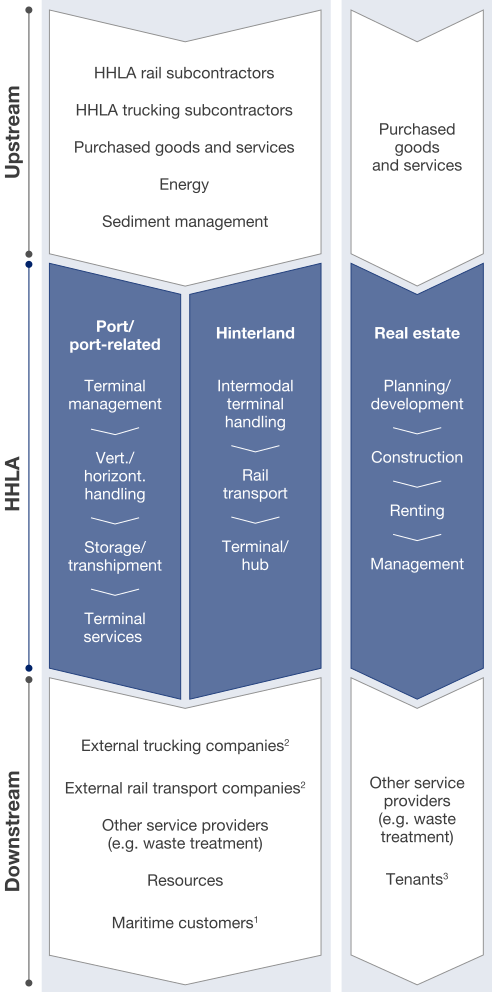
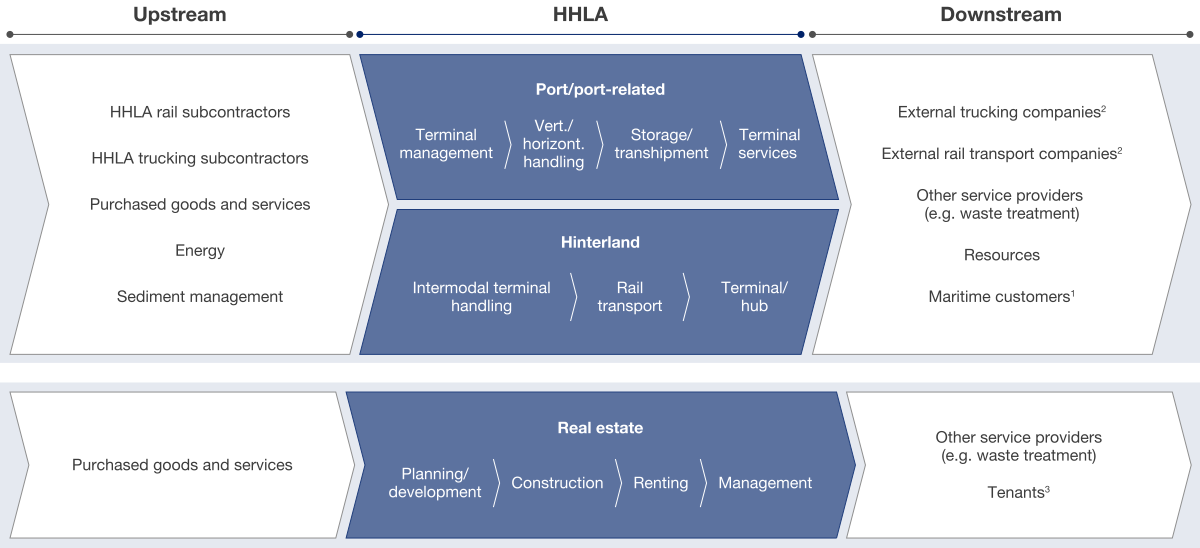
HHLA is firmly established in the continental logistics value chain and has two main value chains itself: one consists of the ports and port-related services plus the added value from the hinterland intermodal segment while the other consists of the Real Estate segment.
The value chain for the ports/port-related services and the hinterland is characterised primarily by interaction between a large number of players in the freight industry. HHLA and its rail subsidiary METRANS link the Northern European and Adriatic ports with Central and Eastern Europe via an intermodal network. HHLA maintains strong relationships with leading logistics companies to ensure fast and efficient processes.
HHLA generates its own direct added value in port-related services with terminal management, vertical and horizontal handling, storage and transshipment, short-distance transport and terminal services. This helps customers to shape their own supply chains. Similarly, HHLA’s direct added value in the hinterland includes intermodal terminal handling, rail and road transport, and the operation of terminals and hubs.
The upstream value chain of the main value chain for ports/port-related services and the hinterland includes rail and trucking companies contracted by HHLA. The main material inputs are the purchased large-scale equipment and the energy used to fuel its operating activities. With a particular focus on Hamburg, sediment management in the port and approach channels is a key factor in ensuring the smooth running of HHLA’s own operating activities.
The downstream value chain comprises external railway and trucking companies, other service providers (e.g. for waste disposal), material resources such as sales of used equipment, and maritime customers.
In its Real Estate segment, HHLA designs commercial and logistics space and promotes urban development. HHLA Real Estate offers sales, commercial property management, facility management, and project development and construction services, providing its customers with professional services from a single source.
HHLA’s properties in the Port of Hamburg and the Speicherstadt historical warehouse district are at the heart of the real estate value chain. Purchased services and goods to ensure property management play an important role here. HHLA’s own value-adding activities including the planning and development, construction, leasing and management of these properties.
HHLA’s value chain
2 Handling during time at HHLA terminals, where there is no existing business relationship
3 HHLA only has commercial tenants.