















Container segment
in € million |
|
2025 |
|
2024 |
|
Change |
|---|---|---|---|---|---|---|
Revenue |
|
843.2 |
|
773.3 |
|
9.0 % |
EBITDA |
|
167.8 |
|
167.8 |
|
- 0,0 % |
EBITDA margin in % |
|
19.9 |
|
21.7 |
|
- 1.8 pp |
EBIT |
|
73.6 |
|
78.7 |
|
- 6.4 % |
EBIT margin in % |
|
8.7 |
|
10.2 |
|
- 1.5 pp |
Container throughput in thousand TEU |
|
6,295 |
|
5,970 |
|
5.4 % |
In the 2025 reporting year, container throughput at HHLA’s container terminals increased significantly year-on-year by 5.4 % to 6,295 thousand standard containers (TEU) (previous year: 5,970 thousand TEU).
Container throughput
in thousand TEU
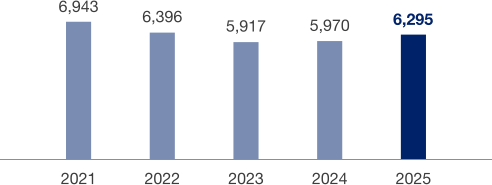
Container throughput at the Hamburg container terminals rose by 4.8 % to 5,956 thousand TEU (previous year: 5,686 thousand TEU). Whereas overseas traffic volumes for the North America shipping region declined strongly, there was volume growth for the Far East – especially China – as well as for South America, Africa, Australia and the Middle East. The ongoing route adjustments caused by the military conflict in the Red Sea also led to significantly higher cargo volumes with other European seaports, especially from the UK, Belgium, Spain and the Netherlands.
Volumes for feeder traffic also increased significantly year-on-year. In addition to the strong rise in Finnish traffic, there was also a strong increase in container throughput with Poland, as well as with other German ports. By contrast, cargo volumes from Estonia, Latvia and the UK were down. The proportion of seaborne handling by feeders was 19.6 % (previous year: 19.4 %).
Meanwhile, the international container terminals reported a strong rise in throughput volume of 19.2 % to 339 thousand TEU (previous year: 284 thousand TEU). In addition to the expected volume growth at HHLA PLT Italy, this was due in particular to the limited resumption of seaborne handling at Container Terminal Odessa (CTO) in the third quarter of 2024. In the previous year, these activities had been completely shut down during the first six months. By contrast, seaborne handling volumes at the multifunctional terminal HHLA TK Estonia decreased slightly.
Segment revenue climbed significantly by 9.0 % in the financial year to € 843.2 million (previous year: € 773.3 million). This was largely due to higher throughput volumes and beneficial shifts in the modal split. The international container terminals also made a positive contribution towards revenue growth: in addition to temporary revenue from sediment deposits, this growth was driven in particular by the overall improvement in the volume and revenue situation, as well as higher storage fees at the TK Estonia and PLT Italy terminals. There were opposing effects from a substantial drop in revenue from grain shipping at CTO in the financial year, compared to the very high level of 2024.
There was a net increase in other operating income and expenses included in the operating result (together defined as EBIT costs) of 11.5 % in the past financial year. This was mainly driven by the positive volume trend and correspondingly higher capacity utilisation. Due to the development of collective wage agreements and the additional deployment of personnel from the general port operations (GHB) pool, there was a strong year-on-year increase in personnel expenses. In addition, there were strong rises in expenses for consultancy and related services, as well as for purchased services. Due to necessary investments, there was a moderate increase in depreciation expenses. The main opposing effects resulted from measures introduced in March 2023 to safeguard earnings at the Hamburg container terminals, as well as further extensive transformation processes within the Container segment.
There was a corresponding decline in the operating result (EBIT) of 6.4 % to € 73.6 million (previous year: € 78.7 million). At 8.7 %, the EBIT margin was 1.5 percentage points down on the previous year (previous year: 10.2 %).
To enhance its energy and cost efficiency, HHLA continued to invest in climate-friendly and state-of-the-art terminal technology. At Container Terminal Altenwerder (CTA), the work to put three replacement container gantry cranes into operation is underway. In addition to the technical commissioning, remote operation and automation processes already completed, this also includes employee training. The second delivery lot is currently being assembled in Cobh, Ireland, and is slated for delivery in Hamburg in the second quarter of 2026.
The infrastructure required for the electrification of tractor units is complete and ten zero-emission units are already in operation. A further ten battery-operated vehicles have been ordered; some of them have already undergone successful tests and are about to be put into operation. As part of the preparations to retire the existing AGV system, extensive adaptations and additions were made to the fence and gate system during the fourth quarter, as well as to the first automated stacking cranes, AGVs and first container gantry cranes. At the same time, the systems are being subjected to lab tests before tests with real equipment begin in the second quarter of 2026. The new system is scheduled to go online in January 2027.
Construction measures for blocks 28 and 29 at Container Terminal Burchardkai (CTB) continued in the reporting period. The first major advance payment for this has already been made. Two new container gantry cranes were put into operation while tests on the new AGV facility are still ongoing. The workshop building constructed as part of the AGV project was handed over in December.
A second rotating spreader for project cargo was also delivered to Container Terminal Tollerort (CTT).